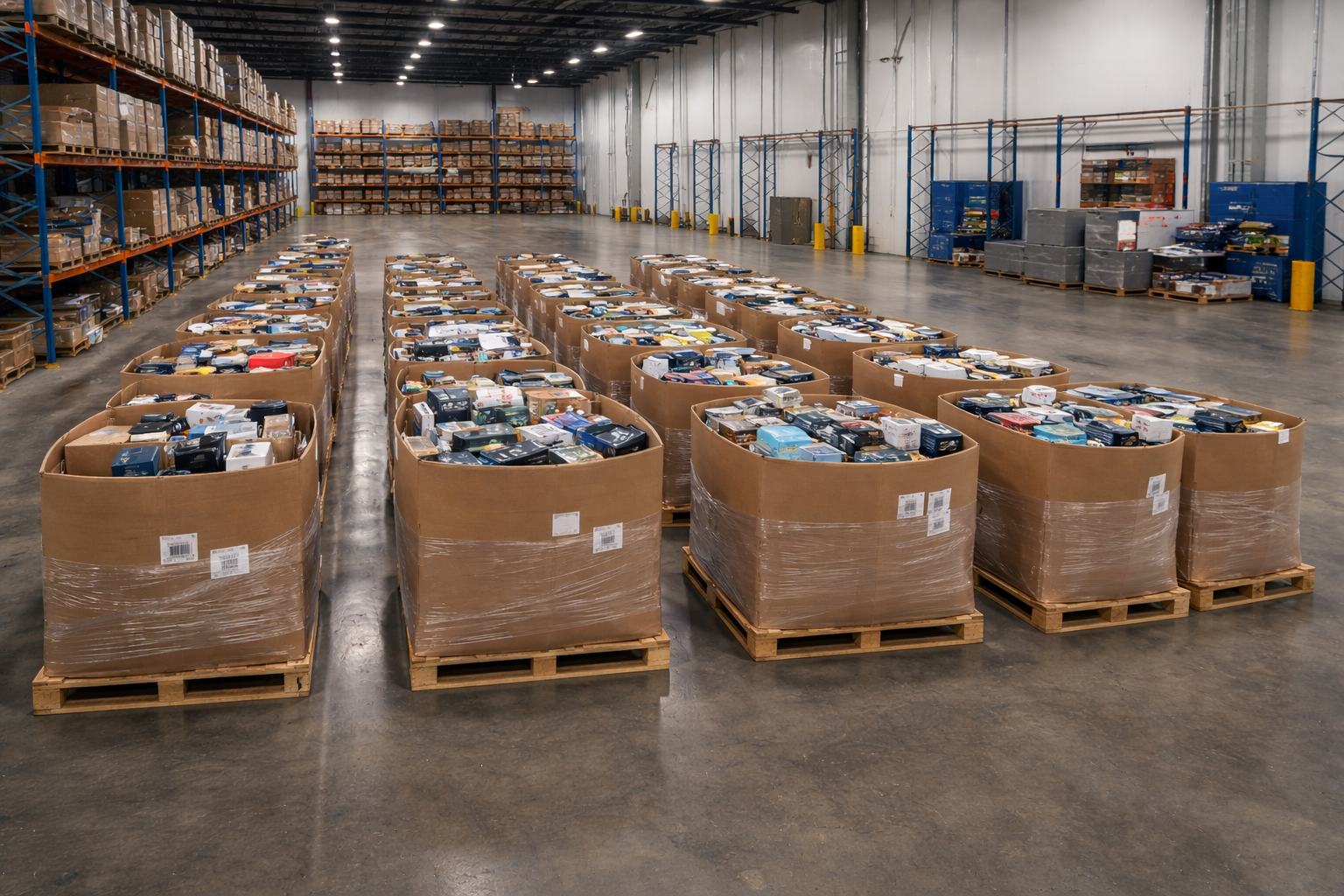
Across retail and consumer goods industries, one operational reality is growing faster than almost any other: unsellable product volume.Returns, overstock, defective goods, expired inventory, recalls, and regulated products such as vapes are now permanent features of modern commerce. Whether products are sold online, in brick-and-mortar locations, or through hybrid models, retailers in nearly every sector are facing the same question:
For many organizations, liquidation has historically been the default answer. At today’s scale, that approach is increasingly misaligned with sustainability goals, regulatory requirements, and consumer expectations.
Retailers across all categories are experiencing sustained pressure from reverse logistics.Industry data consistently shows that 15–20 percent of all retail sales are returned, with online channels often exceeding that range. Even when only a portion of those returns are deemed unsellable, the resulting volume is enormous.Beyond returns, retailers are also managing:
In parallel, packaging waste tied to reverse logistics continues to rise. In many return streams, packaging by weight can equal or exceed the product itself, compounding landfill pressure.At scale, these streams represent millions of units and thousands of tonnes of material per year for large retailers.
Liquidation has a role, but it is often misunderstood as a sustainability solution. In practice, it presents several structural problems.
Liquidators are primarily incentivized to move product that can be resold quickly. When items cannot be sold due to condition, compliance, or lack of demand, they frequently fall outside the liquidator’s core business model.What happens next is often unclear, undocumented, or fragmented.
Industry studies and audits have shown that a significant percentage of liquidated inventory ultimately ends up landfilled or improperly disposed of, especially when:
Liquidation delays disposal but does not guarantee sustainable outcomes.
Vapes and similar regulated consumer products are a clear example of where liquidation breaks down.Returned or unsold vape products often:
Routing these products through resale-focused channels increases compliance risk and environmental exposure, rather than reducing it.
When liquidation and recycling are handled by different parties, retailers often lose visibility once resale attempts fail. This creates:
From a sustainability standpoint, lack of data is equivalent to lack of control.
”Globally, waste volumes are rising faster than waste infrastructure can adapt. Municipal solid waste is projected to grow dramatically over the coming decades, and retail-derived waste is a meaningful contributor. Overstock, returned goods, and unsellable products represent one of the most controllable waste streams retailers have. Unlike consumer behavior, reverse logistics is an internal system that can be redesigned.Treating liquidation as the end of responsibility shifts the problem downstream instead of solving it.
Sustainable product destruction does not mean destroying more. It means destroying intentionally, transparently, and as a last resort, while maximizing responsible recovery.A scalable model includes:
Every unit is evaluated against clear criteria:
This is especially critical for regulated categories such as vapes, cosmetics, personal care, and consumables.
When destruction is unavoidable, sustainability depends on:
This protects both the brand and the environment.
Even when products cannot be reused, responsible processing focuses on:
At scale, this approach materially reduces waste output.
Packaging is often the single largest waste component in reverse logistics. Sustainable programs treat packaging recovery as a core objective, not an afterthought.
Consumers increasingly want to know what retailers are doing behind the scenes. So do regulators, investors, and internal ESG teams.Without tracking, retailers cannot answer basic questions such as:
Data transforms reverse logistics from a cost center into a measurable sustainability function.
ERS works across retail sectors to manage returns, overstock, regulated products, and unsellable inventory through a unified, data-driven approach.
ERS supports programs that combine resale evaluation, secure destruction, and responsible end-of-life processing under one operational framework. This reduces material movement and eliminates lifecycle gaps.
ERS handles mixed streams that include general merchandise, regulated products such as vapes, and complex overstock scenarios, applying appropriate controls to each category.
Inbound material is tracked by origin, category, and disposition pathway, enabling accurate reporting and continuous improvement.
Where reuse is not possible, ERS focuses on responsible processing and recovery to reduce landfill dependency and support circular supply chains.
ERS provides detailed documentation designed to support sustainability reporting, internal audits, and consumer-facing transparency.
Liquidation alone was built for speed and recovery value, not sustainability. At today’s scale and scrutiny, it is no longer sufficient on its own.Retailers that lead will be the ones that:
This is not about eliminating liquidation. It is about recognizing its limits and building a more complete, responsible lifecycle strategy around it.
Returns, overstock, regulated goods, and unsellable inventory are not temporary challenges. They are permanent features of modern retail.Sustainable product destruction, backed by data, integrated processing, and transparent reporting, is how retailers can mitigate landfill impact, advance resource recovery, and earn consumer trust at scale.That is what responsible retail looks like when volume is the reality.