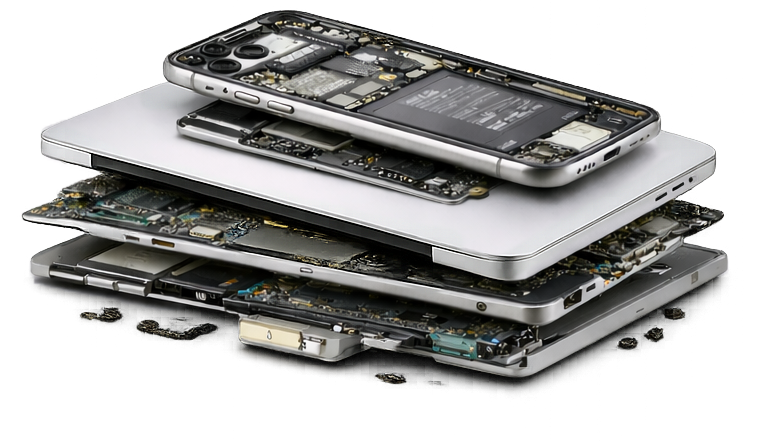
As organizations accelerate digital transformation, cloud adoption, AI investments, and end-user device modernization, the volume of hardware moving through the IT ecosystem is growing faster than ever. IT solution providers — distributors, VARs, MSPs, and systems integrators — play a defining role in how this hardware is sourced, deployed, refreshed, decommissioned, and ultimately processed. And with global pressure mounting around Scope 3 emissions, IT providers now have a unique opportunity to transform routine refresh cycles and take-back programs into measurable environmental impact.This shift isn’t just operational — it’s strategic. It influences sales strategy, customer success, sustainability leadership, ESG reporting, and long-term competitive differentiation.
In the IT industry, the overwhelming majority of emissions fall under Scope 3 — emissions outside of a provider’s direct operations but heavily influenced by its decisions and services. This includes:
Because IT providers handle:
…they sit at the center of influence over how much carbon is created — and how much can be avoided. Your industry has the ability to shift organizations toward a more circular, sustainable lifecycle, where every device lives longer, moves through more value cycles, and generates less environmental impact.
Manufacturing new hardware is one of the most carbon-intensive processes in the technology lifecycle. Extending the useful life of devices through:
…results in massive avoided emissions, because no new device needs to be produced for that next use cycle. This creates measurable Scope 3 reduction opportunities for customers and new financial returns for IT providers.
When devices reach true end-of-life, responsible processing is critical. IT providers oversee:
This stage is often underestimated, but it holds significant value.
Proper end-of-life processing supports:
IT providers who integrate certified end-of-life workflows into their lifecycle programs gain a major advantage in delivering true Scope 3 reductions.
Sustainable IT lifecycle management is no longer a technical afterthought — it is a cross-department strategic priority. For IT providers to maximize Scope 3 impact and customer value, three internal teams must work together:
Sales must be trained to communicate the environmental and financial value of:
Modern customers want sustainability embedded into the front-end conversation, not added later.
Sustainability leaders must:
This turns IT lifecycle programs into measurable, reportable impact.
Executives set the tone. Leadership must:
When leadership supports these programs, they move from optional to standard practice.
ERS helps IT providers transform refresh cycles, take-back programs, and decommissioning workflows into verifiable, measurable Scope 3 reductions.
Here’s how:
✓ Refurbishment and redeployment
✓ Secure data sanitization
✓ Secondary market resale programs that maximize financial return
✓ Reuse-first strategies that produce the highest Scope 3 offsets
✓ Responsible, compliant processing for non-reusable devices
✓ Downstream environmental, health, and safety oversight
✓ Detailed end-of-life documentation, including mass-balance reporting and chain-of-custody records
This supports ESG audits and customer sustainability reporting.
✓ Avoided emissions calculated using recognized methodologies
– ISO 14064
– CDM methodology
– US EPA methodology
✓ Third-party validation
✓ Registry-backed serialization for full transparency
✓ Audit-ready documentation supporting Scope 3 disclosures
ERS turns linear take-back programs into circular, registry-verified climate contributions.
IT providers are no longer judged only by the solutions they implement — but by the sustainability of the lifecycle they enable.
Refresh cycles, take-back programs, decommissioning, and reuse strategies are now strategic levers that determine:
By implementing circular lifecycle programs backed by verified carbon methodologies and registry transparency, IT providers can deliver:
✓ measurable Scope 3 reductions
✓ financial return
✓ stronger customer relationships
✓ true environmental leadership
This is the blueprint for the next decade of sustainable IT.