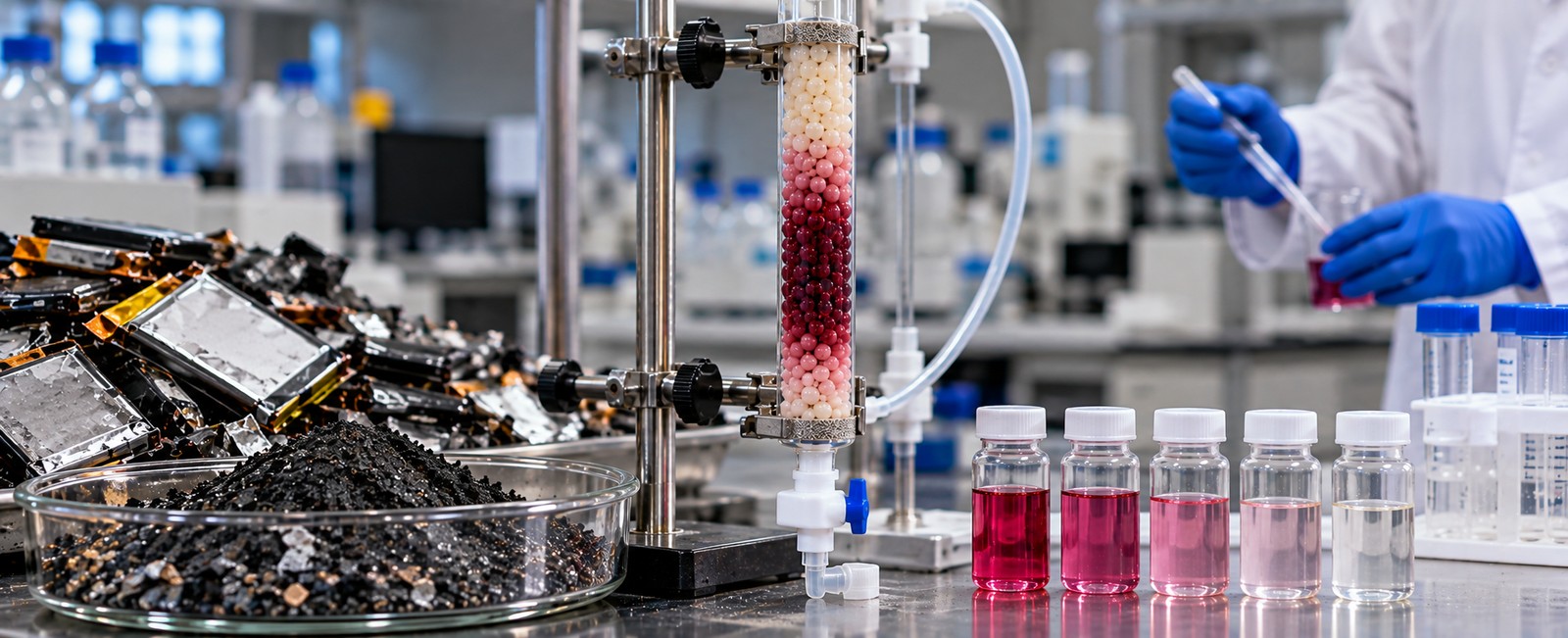
ERS International, working with researchers at the University of Ottawa, has demonstrated a new way to separate the valuable metals inside spent lithium-ion batteries using beads made from chitosan, a biopolymer derived from crustacean shell waste. In a continuous-flow column fed with real battery leachate, the beads captured cobalt and nickel while more than 99% of the lithium stayed in solution.
The results were published on 26 August 2026 in Mining, Metallurgy & Exploration, co-authored by Siamak Kazemeini of ERS International and co-funded by ERS and the Ontario Centre of Innovation.
For background on how ERS already recovers materials from retired technology, What Happens to a Server After It Leaves a Data Center? follows equipment downstream, and our Innovation page covers our wider work on lithium battery recycling and resource recovery.
The authors cite projections that end-of-life lithium-ion batteries could exceed 11 million tonnes by the end of the decade, while global recycling capacity sits near 2 million tonnes a year. Regulation is raising the bar too: the EU Battery Regulation requires 50% lithium recovery from spent batteries by 2027 and 80% by 2031.
Dissolving battery cathodes is the easier step. Separating the dissolved lithium, cobalt, nickel and manganese from each other is a major bottleneck, because conventional methods such as solvent extraction and precipitation consume large amounts of reagents and create secondary waste.
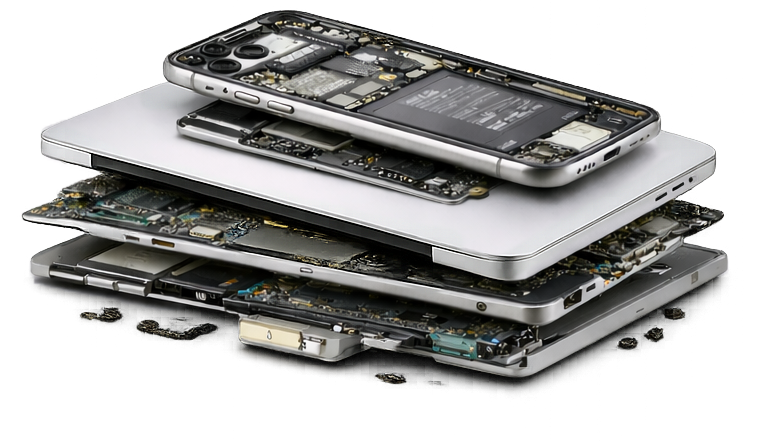
The team worked with real waste, not synthetic lab solutions. Spent batteries from laptops, phones and Li-polymer packs were collected from a Toronto recycling facility, discharged, dismantled and combined into a "black mass" of three common cathode chemistries (LCO, NMC and LMO).
That black mass was dissolved using the group's earlier citric-sulfuric acid leaching method, which works without added reducing agents. The resulting solution was diluted and fed through a glass column packed with millimetre-sized chitosan beads crosslinked with 1% L-cystine, an amino acid that adds sulfur-containing binding groups.
The beads come from the team's January 2026 study in Mineral Processing and Extractive Metallurgy Review, which compared two amino-acid crosslinkers and found that L-cystine produced the most efficient, stable beads in batch tests. This new work is the next step, taking those beads from flasks into a continuous column.
Most earlier chitosan studies were run in small batch flasks at low metal concentrations. Here the feed carried roughly 964 mg/L of cobalt, 60 mg/L of nickel, 46 mg/L of manganese and 133 mg/L of lithium, and the team tested two flow rates and two bed heights in continuous operation.
Lithium was effectively untouched: less than 1% was taken up by the beads in every run, so it stays in solution for a separate recovery step. Meanwhile cobalt and nickel were captured strongly, and manganese only weakly.
Uptake figures are milligrams of metal per gram of beads; the lower nickel and manganese values largely reflect their lower concentrations in the feed.
This is a milestone in ERS's ongoing research with the University of Ottawa on cleaner battery recycling. It shows that a waste-derived, biodegradable material can perform selective separation in continuous flow at realistic leachate strength, not only in small batch tests. That makes the beads a strong candidate for a post-leaching step in hydrometallurgical recycling, splitting cobalt and nickel away from lithium so each stream can be processed separately.
The work is a mini-pilot proof of concept with a clear path forward. Column capacity was roughly half of batch-test values and manganese was weakly retained. Next steps include:
ERS International manages end-of-life electronics, including battery-containing devices, through certified electronics recycling and resource recovery. Our collaboration with the University of Ottawa supports that work by developing cleaner ways to recover critical metals such as cobalt and nickel once batteries reach a recycler. If your organization generates spent batteries or battery-containing devices, our team can help plan collection, handling and recycling.
Chitosan is a biopolymer made from chitin, found in crustacean shells. Its amine and hydroxyl groups bind metal ions, and it is biodegradable and non-toxic, which makes it a promising low-impact material for separating metals.
Not directly. The beads capture cobalt and nickel and leave more than 99% of the lithium in solution, so lithium can then be recovered separately from a cleaner stream.
Yes, in this study they were used over two adsorption and regeneration cycles. An EDTA wash released 81% to 100% of the cobalt and nickel, with some loss of capacity in the second cycle.
Not yet. The study is a mini-pilot proof of concept. Longer cycling, scale-up and cost studies are needed before industrial implementation.
Roshanfar M, Sartaj M, Kazemeini S (2026). Crosslinked Chitosan Bio-Sorbent Column for Critical Metal Recovery from Spent Lithium-Ion Batteries. Mining, Metallurgy & Exploration. Published online 26 August 2026.
Earlier study: Roshanfar M, Sartaj M, Kazemeini S (2026). Synthesis, Process Optimization, and Statistical Analysis of Chitosan-Based Biosorbent Beads for Selective Lithium Recovery in Lithium-Ion Battery Recycling. Mineral Processing and Extractive Metallurgy Review. Published online 16 January 2026.
Melina Roshanfar and Majid Sartaj are with the Department of Civil Engineering at the University of Ottawa; Siamak Kazemeini is with ERS International in Toronto. The project was funded by the Ontario Centre of Innovation and ERS International (OCI application 36895).
Talk with ERS International about safe collection, certified recycling and recovering value from your retired technology.